Radiator Leaking? Causes, Temporary Fixes and When to Call a Plumber
A damp patch under a radiator is rarely dramatic, but it never fixes itself. Here is where radiators leak, how to pinpoint the exact spot, the temporary measures worth doing, and the honest line between a manageable drip and a job for a plumber.
A radiator leaking water usually announces itself quietly. You notice a rusty tide mark on the skirting, a patch of damp on the carpet that keeps coming back, or a faint metallic smell in a room that has otherwise been fine for years. It rarely arrives as a flood, which is exactly why so many people leave it. The trouble is that radiator leaks almost never improve on their own. A weep becomes a drip, a drip becomes a steady loss of pressure, and a system that keeps dropping pressure is a system that will eventually leave you without heating or hot water.
The good news is that most radiator leaks are understandable once you know where to look. There are only a handful of places a radiator can leak from, and each one points to a different cause and a different fix. This guide walks through all of them, how to identify the exact point, what you can sensibly do yourself as a temporary measure, and where the honest line sits between something manageable and something that needs a plumber. We serve homes across London, and this is broadly the order in which we think about a leak when we arrive on site.
The five places a radiator actually leaks from
Before you can fix anything, you need to know what is leaking. Water travels, so the puddle on the floor is almost never directly below the fault. It runs along the bottom of the radiator, drips from the lowest point, and lands somewhere that tells you very little. The skill is in finding the true source, and that means drying everything, then watching.
Broadly, a radiator leaks from one of five points, and each behaves differently.
1. Radiator valve leaking at the union nut
At each end of a radiator there is a valve: a thermostatic or manual valve at one side, and a lockshield valve at the other. Where the valve meets the radiator there is a union nut, and where the valve meets the pipe from the floor or wall there is a compression joint. These threaded connections are the single most common place for a radiator to leak, because they rely on a seal that can loosen with the constant expansion and contraction of heating and cooling.
A radiator valve leaking at the union is often intermittent. It may be dry when the radiator is cold and weep only once the system heats up and the metal expands, or the other way round. If you dry the valve completely and find water reappearing at the nut or the base of the valve body, this is your culprit. Valve leaks are frequently the most fixable of all radiator leaks.
2. The valve spindle or gland
Inside a manual or thermostatic valve is a spindle that moves when you turn it. It is sealed by a gland nut and packing. Over years of use, and especially if a valve has not been turned for a long time and is then operated, this seal can start to weep from around the spindle itself rather than from the union nut. You will see water appearing higher up, right where the head or handle meets the valve body. Sometimes gently nipping up the gland nut cures it; sometimes the packing needs replacing.
3. The radiator body: corrosion and pinholes
This is the leak people dread, and rightly so. When water appears to be coming from the face or the seam of the radiator itself rather than from any fitting, the radiator is corroding from the inside out. These are pinhole leaks, and they are a symptom of what is happening throughout the system rather than a local fault. We will come back to why sludge causes them, because it is the part most people misunderstand.
4. The bleed valve
At the top corner of the radiator sits the small square bleed valve you open with a radiator key to release trapped air. If it has been over-tightened, cross-threaded, or left slightly open after bleeding, it can weep. This is usually a small leak and often one of the more straightforward to sort, sometimes just by closing it properly or replacing the valve.
5. The blanking plug or tail
The remaining corners of the radiator hold a blanking plug and an air vent. Like the bleed valve, these are sealing points that can loosen or corrode over time, and they occasionally weep in the same way a valve union does.
How to identify the exact leak point
Guessing wastes time and money. Spend ten minutes narrowing it down properly and you will know whether this is a two-minute nip-up or a radiator replacement.
- Dry everything first. Wipe the entire radiator, both valves, both bottom corners and the pipes bone dry with kitchen roll or an old towel. You cannot trace a leak through existing wetness.
- Lay dry tissue at each suspect point. Wrap a strip of toilet roll around each valve, the spindle, the bleed valve and any visible seam. Tissue shows the first trace of moisture far more clearly than metal.
- Watch through a heat cycle. Many leaks only appear when the system is hot and under pressure, or conversely as it cools. Let the heating run, then check each tissue after fifteen to thirty minutes, and again once cool.
- Look above the puddle, not at it. Follow the water upward. The highest dry-to-wet transition point is your source. If the top of the radiator body is wet and it is not the bleed valve, you are likely looking at a pinhole.
- Note whether it is constant or cyclical. A constant drip regardless of temperature often points to a compression joint or a body leak. A leak that comes and goes with heating usually points to a valve union that moves with expansion.
This is also, honestly, where a lot of DIY threads on the likes of r/DIYUK and DIYnot land on the same conclusion: the hard part is not fixing the leak, it is being certain where it actually is. The general forum consensus is consistent and sensible. Nip up valve nuts gently before doing anything drastic, be very wary of internal sealants, and accept that a genuine body pinhole means the radiator is on borrowed time. That matches what we see in real homes.
Leak point, likely cause and what to do
| Leak point | Likely cause | Sensible action |
|---|---|---|
| Radiator valve leaking at the union nut | Seal loosened by expansion and contraction | Gently tighten a quarter turn while holding the valve body; if it persists, the joint needs remaking |
| Compression joint (valve-to-pipe) | Olive or nut worked loose, or original seal failing | Careful nip-up may cure it; a failing olive needs a plumber to remake the joint |
| Valve spindle or gland | Worn packing around the spindle | Nip the gland nut slightly; if weeping continues, repack or replace the valve |
| Bleed valve (top corner) | Left open, cross-threaded or worn | Close fully with a radiator key; if still weeping, replace the bleed valve |
| Blanking plug or air vent | Loosened or corroded seal | Tighten carefully; replace the fitting and washer if it continues |
| Radiator body or seam | Internal corrosion causing a pinhole | Catch the water and control it, then plan replacement; sealant is a stopgap at best |
Temporary fixes that are actually worth doing
A temporary fix has one job: to control the situation and protect your home until it is repaired properly. It is not a permanent cure, and treating it as one is how small leaks become expensive ones. Here is what genuinely helps.
Gently tightening a leaking valve
If the leak is at a valve union or compression nut, the honest first move is a careful tightening. Hold the body of the valve still with one adjustable spanner so it cannot twist and strain the pipework, and turn the nut only a small amount, a quarter turn at most, with a second spanner. The key word is gently. Over-tightening can crush an olive, distort a thread or crack an old brass fitting, and turn a weep into a proper leak. If a small nip does not stop it, stop there and call in help rather than forcing it.
Catching and controlling the water
For any leak you cannot immediately stop, contain it. Place a wide, shallow container under the drip and lay old towels around the base to protect flooring and skirting. For a slow weep, tying a thick cloth around the leaking joint so it wicks water into a container below buys you time and keeps the floor dry. This is unglamorous, but preventing water damage to floors and ceilings is often worth far more than the repair itself.
Isolating the radiator
A radiator leaking badly can often be taken out of use without shutting down the whole system. Close both valves: turn the thermostatic or manual valve to off or zero, then close the lockshield valve at the other end, counting the exact number of turns so it can be reset later to keep the system balanced. With both valves closed, the radiator is isolated and the leak from the valves should slow or stop, letting the rest of your heating carry on. A body pinhole, however, may keep weeping the water already inside the radiator, so keep containing it.
A word on radiator sealant
Internal leak-sealer additives, the kind you add to the system, are one of the most argued-about topics on DIY forums, and the balanced view is worth stating plainly. Sealant can buy time on a genuine internal pinhole, and it occasionally works well enough to defer a replacement. But it is a gamble, not a fix. It can partially block valves, radiators and, most worryingly, the narrow passages inside a boiler or heat exchanger. If your leak is at a joint or valve, sealant is the wrong tool entirely and you should mechanically fix the joint instead. If it is a body pinhole, understand you are buying weeks or months, not solving the problem, and mention it to whoever next services your boiler. We would rather be honest about that than sell you a bottle of hope.
Why corrosion and sludge cause pinholes
Pinhole leaks are not bad luck. They are the visible end of a slow internal process, and understanding it explains a lot about why radiators fail and why one leak often signals more to come.
A sealed central heating system holds the same water going round and round. Over the years, oxygen and dissolved minerals react with the steel inside your radiators and produce a black, iron-oxide sludge, essentially magnetite. This is the black gunk that comes out when a radiator is drained, and the dark staining on old bleed water. As sludge builds, it settles in the bottom of radiators, which is why a cold bottom and warm top is such a common complaint. That sitting sludge holds moisture against the steel and drives localised corrosion from the inside. Eventually the metal is eaten through at a weak point and a pinhole opens, typically low on the radiator where the sludge collects.
The important takeaway is that a pinhole leak is a system symptom, not just a single duff radiator. If one radiator has corroded through, others in the same system are travelling the same road. This is why a proper repair is not only swapping the leaking radiator but thinking about the water quality across the whole system: a power flush or chemical clean to remove sludge, and a corrosion inhibitor added afterwards to slow the process down. Skip that, and the new radiator simply starts the same clock again.
How a leak affects system pressure
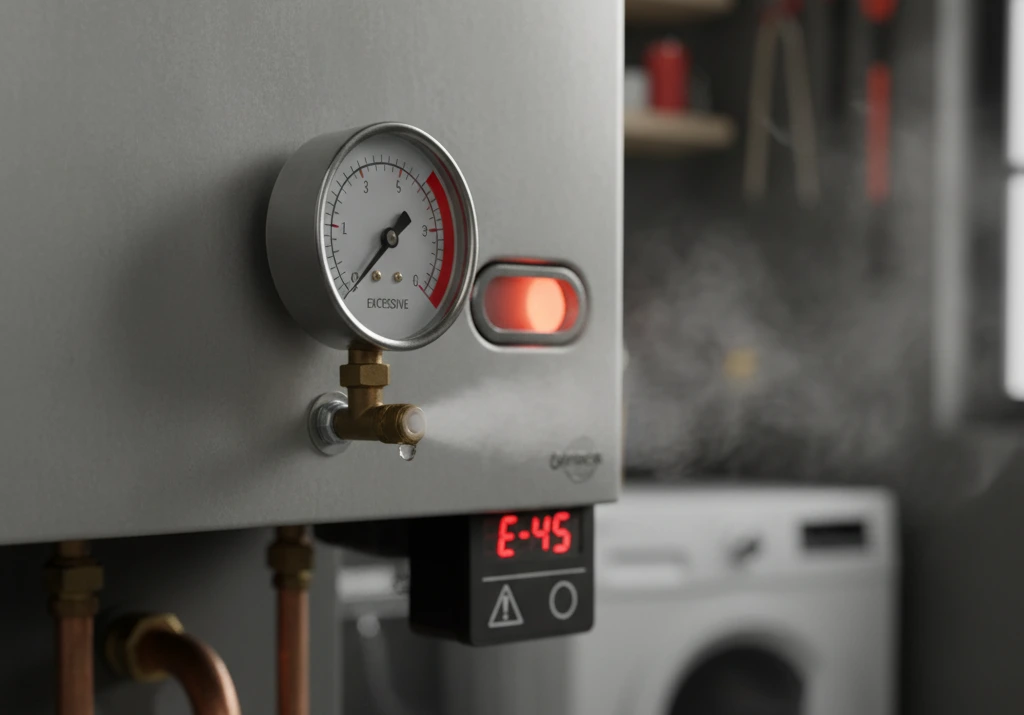
On a modern combi or sealed system boiler there is a pressure gauge, usually reading somewhere between one and one and a half bar when cold. A radiator leak, even a slow one, means the system is continuously losing water, and that shows up as pressure that keeps dropping. You top it up, it falls again over days or weeks, and that slow decline is one of the clearest signs of a leak somewhere in the system rather than a one-off.
If pressure drops far enough, many boilers cut out on a low-pressure fault and you lose heating and hot water altogether. Repeatedly topping up masks the leak and, over time, introduces fresh oxygenated water that actually accelerates internal corrosion, making future pinholes more likely. So a dropping gauge is not something to keep quietly refilling; it is a prompt to find and fix the loss. If you need to bring pressure back up in the meantime, our guide on how to repressurise a boiler walks through it safely. And if the pressure keeps falling with no radiator obviously wet, the leak may be hidden in pipework, which is where central heating leak detection comes in.
When it needs replacement rather than repair
Joints, valves, glands, bleed valves and blanking plugs can almost always be repaired or their parts renewed. The radiator itself is a different question. Once the body has corroded through and produced a pinhole, you cannot reliably repair it. Welding a thin, rusted panel radiator is not practical, and sealant is a stopgap. If the leak is coming from the body, plan on replacing the radiator.
Signs that point to replacement rather than repair include water genuinely emerging from the face or seam of the radiator, multiple weep points appearing, heavy internal sludging with persistent cold spots at the bottom, and a radiator that is old, thin and already patched. When we see one corroded-through radiator, we always talk about the wider system, because the underlying cause is the water, not just that one panel.
Emergency or manageable? The honest line
Not every leak is an emergency, and we will tell you honestly which yours is rather than rushing you.
Manageable covers the majority: a slow weep at a valve or bleed point, a small drip you can catch in a container, or a radiator you can isolate by closing both valves. If you can contain the water and the boiler is holding pressure well enough to keep working, this is a booked repair, not a panic. Control the water, isolate if you can, and get it looked at in the next day or two before it worsens.
Genuine emergencies are leaks you cannot control: water running freely from a split, spraying from a joint you cannot close off, pressure collapsing so the boiler will not run, or water reaching electrics, ceilings or a downstairs room below the leak. If closing the radiator valves does not stop it, or water is spreading and threatening the building, that is when to shut the system down and call for help quickly.
When you do call us, we work the way we would want to be treated. We give an honest arrival window rather than a vague all-day wait, and the price is agreed before we travel, so there are no surprises when we walk through the door. Our engineers are also leak-detection specialists, which matters when the water is not coming from an obvious radiator joint but from pipework buried in a wall or under a floor. If you want the fastest route to a person, our emergency plumber in London page is the place to start. A radiator leak caught early is usually a small, cheap job. Left to run, it becomes damaged floors, stained ceilings and a boiler that will not stay on, so the honest advice is simple: contain it, then get it seen.
Typical UK trade cost-guide ranges
Prices vary with access, parts and how much of the system needs attention, and we always confirm the figure with you before we travel. As a rough cost-guide, remaking or tightening a leaking valve joint is usually one of the cheaper jobs; replacing a radiator valve sits a step above that; supplying and fitting a replacement radiator is higher again depending on size and type; and a system clean or power flush to tackle the underlying sludge is a larger planned job. Treat these as general trade ranges rather than a quote. The specific number for your home is something we agree up front, in writing, before any work or travel.
Frequently asked questions
Can I still use my heating if one radiator is leaking?
Often yes. If the leak is at the valves, you can usually isolate the affected radiator by closing both the thermostatic (or manual) valve and the lockshield valve, counting the lockshield turns so it can be reset later. The rest of your heating can then run normally. If the leak is a pinhole in the radiator body, closing the valves will stop fresh water reaching it but the water already inside may keep weeping, so keep it contained until it is repaired.
Is a radiator leaking water an emergency?
Usually not. A slow weep you can catch in a container, or a radiator you can isolate by closing its valves, is a booked repair rather than a panic. It becomes an emergency when you cannot control the water: a free-running split, a joint you cannot close, pressure collapsing so the boiler will not run, or water reaching electrics or a room below. If closing the valves does not stop it, shut the system down and call for help promptly.
Why does my boiler pressure keep dropping?
A steady drop in pressure over days or weeks almost always means the system is losing water somewhere, and a radiator leak is a common cause. Repeatedly topping up masks the problem and introduces fresh oxygenated water that speeds up internal corrosion. Rather than keep refilling, it is worth finding the source. If no radiator is obviously wet, the loss may be in hidden pipework, which is where leak detection helps.
Does radiator leak sealant actually work?
It can buy time on a genuine internal pinhole, but it is a stopgap, not a cure, and it carries real risk. Sealant can partially block valves, radiators and the narrow passages inside a boiler. For a joint or valve leak it is the wrong tool entirely; those should be fixed mechanically. For a body pinhole, understand you are deferring a replacement by weeks or months, not solving it, and always tell whoever next services your boiler that sealant has been used.
Why do radiators develop pinhole leaks?
Because the same water circulates for years and slowly corrodes the steel from the inside, producing a black iron-oxide sludge that settles in the bottom of radiators. That sludge holds moisture against the metal and drives localised corrosion until it eats through at a weak point, usually low down where the sludge collects. A pinhole is therefore a symptom of the whole system's water quality, not just one faulty radiator, which is why a clean and a corrosion inhibitor matter after a repair.
Should I repair or replace a leaking radiator?
It depends on where it leaks. Valves, glands, bleed valves and blanking plugs can nearly always be repaired or their parts renewed. But once the radiator body itself has corroded through and produced a pinhole, it cannot be reliably repaired and should be replaced. If one radiator has corroded through, it is worth looking at the wider system, because the underlying cause is the water and others may be heading the same way.