Blocks, offices, hotels, schools
Commercial Leak Detection
In a commercial building or residential block, an unlocated leak is more than damage — it is closed floors, unhappy leaseholders, hygiene risk and a service-charge dispute waiting to happen. The economics are simple: precise detection costs a fraction of speculative opening-up in an occupied building.
Quick answer
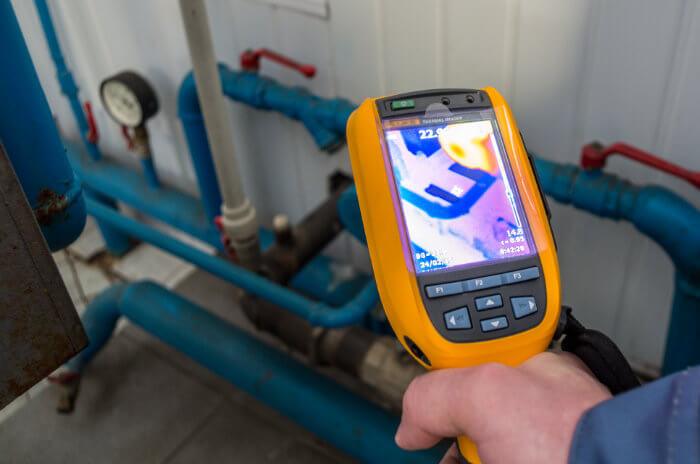
Commercial leak detection in London pinpoints hidden leaks in blocks, offices and retail units using thermal imaging, acoustic and moisture tracing. Surveys can run out of hours to avoid disrupting trading, and reports are prepared insurer-ready for block and commercial policies.
Commercial leak detection costs in London
| Job | Typical cost | Time |
|---|---|---|
| Commercial site survey | £300 to £650 | 2 to 4 hours |
| Out-of-hours survey | £450 to £900 | 3 to 5 hours |
| Multi-flat or riser investigation | £500 to £1,200 | Half to full day |
| CCTV drainage survey | £350 to £750 | 2 to 4 hours |
| Insurer-ready report | £120 to £300 | 1 to 3 days |
Typical UK trade cost-guide ranges, not a quote. Our detection is charged at a fixed hourly rate quoted at booking, under no find, no fee.
We survey commercial and communal systems across London: boosted cold-water risers, heat networks, plant rooms, roof-level tanks and long distribution runs. Correlator-based acoustic work suits large-bore pipework, and out-of-hours surveys keep trading floors and residents undisturbed.
Reporting is built for decision-makers: what is leaking, where, what it affects, and what fixing it involves — in a format managing agents can circulate as-is.
Commercial surveys are quoted per building and system scope; framework rates available for managing agents with recurring requirements.
What you get
- Risers, heat networks, plant rooms and mains distribution
- Out-of-hours and weekend surveys for occupied buildings
- Acoustic correlation for large-bore and long-run pipework
- Flat-to-flat leak origin investigations for managing agents
- Management-ready reports with costed recommendations
- Planned leak-survey programmes for portfolios
How it works
Surveying a working building without closing it
01
Scope with the manager
Drawings, access and symptoms reviewed before we attend — one visit, prepared.
02
Survey the systems
Each circuit is isolated and tested; communal and private supplies distinguished.
03
Pinpoint and prioritise
Leaks located and ranked by risk to fabric, occupants and cost.
04
Report for action
Findings, evidence and next steps circulated to all stakeholders.
Before you book anyone
6 things to check before you book commercial leak detection in London
01
Know the going rate before anyone quotes you
UK leak detection pricing runs from roughly £80 for a basic single-room inspection to £1,600 for complex jobs, with most surveys landing around £500. For commercial premises in London — offices, retail units, plant rooms, multi-let blocks — expect £550 to £1,250 for a proper survey, because pipe networks are larger and circuits take longer to isolate and test. Any quote far below that range usually means one engineer, one method and an hourly meter running. Get the full survey price in writing before the van leaves the depot, not after.
02
The uncapped-rate trap costs more than the headline suggests
Firms advertising £80–£120 per hour look cheap until the invoice arrives: travel time, parts runs and a second visit all get billed, and buried pipework under screed or suspended floors can absorb days. Leaseholders describe open-ended detection running into thousands before a leak is finally located. A fixed hourly detection rate agreed at booking — the model we work to, backed by a genuine no-find-no-fee — caps your exposure before anyone lifts a floorboard. Ask one question: "What is the total price if you don't find it?"
03
Ask what equipment actually arrives on the day
No single method finds every commercial leak. Thermal imaging misses cold-water leaks under insulated screed; acoustic microphones struggle over plant-room noise; a pressure test tells you which circuit is losing water but not where. A competent commercial survey needs acoustic ground mics and correlators, thermal imaging, tracer gas (5% hydrogen in nitrogen — safe and non-flammable), moisture mapping and per-circuit pressure testing on the same visit. If a firm carries one gadget, you are paying for a guess. Ask for the method list in writing before booking.
04
Check the report will survive your loss adjuster
Trace and access cover on commercial property policies is often generous — domestic policies typically cap it around £5,000, while commercial limits run higher or unlimited — but adjusters reject vague reports. A one-line invoice saying "leak found and repaired" will not evidence cause, origin or the access work needed. Insist on a report stating cause and point of origin, methods used, a moisture map and photographs. We issue trace and access reports structured for UK loss adjusters within 48 hours; whoever you use, confirm the report format before paying a deposit.
05
A metered leak is burning cash — and the allowance clock is ticking
Industry analysis suggests a leak of one litre per second can add around £60,000 a year to a commercial water bill. Businesses on a meter pay for every lost litre, and the supply pipe from the boundary into your building is your responsibility, not the water company's. Thames Water's non-household code of practice allows a leakage allowance claimed through your water retailer — but typically only if the leak is repaired within six weeks of confirmation, and not if you knew about it and sat on it. Book detection promptly and keep dated evidence.
06
In multi-let and mixed-use buildings, establish who pays before you commission
The most bitter disputes in London blocks are not about the leak — they are about the bill. Communal risers, stacks and mains are usually the freeholder's or managing agent's responsibility, recoverable through the service charge; pipework serving only one demised unit usually falls to that leaseholder or tenant. Check the lease and confirm in writing who is instructing and paying before the survey. A detection report that pinpoints origin to a specific pipe run is precisely what settles the communal-versus-demised argument — commission it jointly if ownership is unclear.
Compare like for like
Commercial Leak Detection for London Blocks and Offices
Leaks in commercial buildings rarely stay in one flat or unit. Water travels through concrete frames, service voids and shared risers, so tracing the true source takes method and patience. We survey blocks, offices, retail and mixed-use premises across London, working to keep tenants trading and residents undisturbed.
| What to check | A cheap hourly quote | A domestic-only firm | London Leak Specialist |
|---|---|---|---|
| Minimising downtime and disruption | Rushes to bill more hours, often opening walls and floors before the source is confirmed on site. | Set up for a single home; a busy office or shop floor stretches their approach and prolongs works. | We plan the survey around trading hours and occupied units, aiming to trace before any building fabric is opened up. |
| Out-of-hours and weekend surveys | Charges premium call-out rates and may not be available outside a standard working day. | Geared to daytime domestic visits, so evening or weekend commercial slots are hard to arrange. | We offer evening and weekend surveys so retail units and offices can keep operating during core hours. |
| Coordinating access across tenants | Turns up for one visit and leaves; little effort to line up multiple leaseholders or tenants. | Used to a single occupier, so juggling access across several flats or units is outside their usual routine. | We help coordinate access across tenants, leaseholders and managing agents so a whole riser can be checked in one visit. |
| Insurer-ready reports | Provides a brief invoice with no findings a block insurer or managing agent could rely on. | Issues basic domestic notes, rarely suited to block policies or service-charge disputes. | We produce clear written reports with findings and images, suitable for block insurers and service-charge discussions. |
| Tracing water in concrete-frame buildings | Guesses at the source, risking damage in the wrong unit when water has tracked along the frame. | Comfortable with simple house layouts, less so with slabs, screeds and shared structural voids. | We use thermal imaging, moisture mapping and tracer methods to follow how water travels through concrete frames. |
| Handling mixed-use and shared services | Treats the job as a single leak, missing shared pipework serving flats above commercial units. | Focused on one property type, so retail-below-residential layouts fall outside their usual work. | We map shared cold, hot and heating services across mixed-use premises to identify which system is actually leaking. |
| Pricing model | Leads with a low hourly figure that grows once extra visits and opening-up works are added. | Prices by domestic job type, which can misjudge the scale of a commercial or communal survey. | We quote against typical UK trade cost-guide ranges for the survey, agreed in writing before we start. |
From the forums
What commercial leaks cost while nobody finds them
London leaseholders, landlords and facilities managers vent regularly on Reddit about leak investigations that drag on for months, invoices that balloon, and blame games between flats, agents and freeholders. The same hard-won lessons come up again and again.
On r/HousingUK, leaseholders describing managing agents who sit on leak reports
A recurring story: a leak is reported to the managing agent, months pass with no official updates, and residents learn more through the building WhatsApp group than from the agent. One resident described a basement leak investigation still unresolved after a year, handled by a plumber with no traceable company behind him. The consensus is to put everything in writing, chase relentlessly and escalate to the freeholder or ombudsman. Our take: a same-week detection survey with a written report gives the agent nothing left to investigate — it converts a stalled complaint into an actionable repair instruction.
On r/HousingUK, owners arguing over communal versus demised pipework
Threads about blocks of flats repeatedly turn on one question: is the failed pipe communal or does it serve a single unit? Management companies are accused of reflexively declaring leaks "not a communal issue" to keep them off the service charge, while leaseholders lack the evidence to push back. The community's advice is to check the lease wording and demand proof of the leak's origin. Our take: this is exactly what a detection report is for — an origin pinpointed to a named pipe run, with photos and a moisture map, settles the liability question before it becomes a legal one.
On r/DIYUK, people weighing a leak detection specialist against a local plumber
When someone posts about low pressure, damp patches or a boiler losing pressure, the thread usually splits: some say get a general plumber first, others warn that plumbers locate leaks by opening up ceilings and floors until they find water. One flat owner described a management company's plumber knocking "a great big hole" in the ceiling as step one. The emerging consensus favours non-invasive specialists for anything buried or concealed. Our take: acoustic, thermal and tracer gas methods exist precisely so the first hole cut is the last — directly over the leak.
On r/DIYUK and r/HousingUK, homeowners burned by open-ended trace and access costs
Posters describe insurers approving trace and access, then watching detection bills climb — one reported nearly £4,000 spent chasing a leak under suspended floors with no result yet. Others discovered too late that their policy capped the cover or excluded the repair itself. The forum advice is to confirm the trace and access limit, agree costs before work starts and keep every invoice. Our take: a fixed hourly detection rate agreed at booking makes the claim predictable for you and easy for the adjuster — no open meter, no surprise shortfall between the bill and the policy limit.
On r/DIYUK, metered customers shocked by water bills revealing hidden leaks
A common thread pattern: a meter is fitted, the first bill shows several hundred litres a day of unexplained usage, and the poster asks whether the meter is faulty. The community's standard test — shut the internal stop tap and watch whether the meter still spins — usually confirms an underground supply pipe leak, followed by debate over DIY excavation versus quotes around £1,000. Our take: for a business the stakes are higher, since metered losses hit the bottom line monthly; tracer gas and acoustic correlation locate a buried supply leak without speculative digging across a car park or forecourt.
Questions
Commercial leak detection: access, hours and reporting
Can you survey without disrupting the building?
Yes — non-invasive methods need access, not demolition. We work floor by floor with the building team, and out-of-hours where daytime access is impossible. Occupants usually notice nothing beyond an engineer with a camera and headphones.
A leak keeps appearing in different flats — same source?
Very often, yes. Water tracks along slabs and service voids and surfaces far from its origin, which is how one riser leak becomes three separate complaints. Origin tracing across the affected stack is exactly what we do for managing agents.
Do you work with our appointed contractors?
Happily. We locate and document; your term contractor repairs and makes good. Our report gives them a precise target instead of an exploratory brief.
How much does commercial leak detection cost in London?
Commercial surveys in London commonly run £550 to £1,250 across the trade, depending on building size, number of water circuits and access. We price ours at a fixed hourly rate agreed before we attend, so the figure follows the hours the building actually needs. Simple single-circuit jobs sit at the lower end; multi-let blocks, plant rooms and buried external mains cost more. Nationally, leak detection ranges from about £80 to £1,600 with an average around £500. Beware low hourly rates (£80–£120) — open-ended billing on a large building often exceeds a fixed survey price.
Who is responsible for fixing a water leak in a commercial building?
The property owner is responsible for the supply pipe from the property boundary into the building, plus all internal pipework — the water company only maintains the main and communication pipe in the highway. In multi-let buildings, communal risers and mains are normally the freeholder's or managing agent's responsibility (recoverable via service charge), while pipework serving one demised unit falls to that tenant or leaseholder. The lease wording decides borderline cases, so check it before commissioning work.
Can a business claim a leak allowance on its water bill?
Often, yes. Under Thames Water's non-household code of practice, businesses can claim a leakage allowance for water lost through a hidden leak, submitted via their water retailer. Conditions apply: the leak generally must be repaired within six weeks of being confirmed, and claims fail if the leak was caused by negligence or you knew about it and delayed. Keep the detection report, repair invoice and dates — they form the evidence for the claim.
How long does a commercial leak detection survey take?
Most domestic leak investigations take one to three hours, but commercial surveys usually need half a day to a full day. Each water circuit must be isolated and pressure tested separately, and larger buildings have longer pipe runs to trace with acoustic and tracer gas equipment. Multi-storey or multi-let buildings with plant rooms can take longer. Out-of-hours surveys are worth asking about if isolating water during trading hours would disrupt the business.
Does commercial property insurance cover leak detection?
Usually, through trace and access cover, which pays the cost of locating a hidden leak and making good the access work — though not the pipe repair itself or resulting damage, which fall under other policy sections. Domestic policies typically cap trace and access around £5,000; commercial policies often carry higher or unlimited limits. Insurers expect a professional report evidencing cause and origin, and most require the leak to be reported promptly, so do not delay.
Is a hidden water leak in business premises an emergency?
Treat it as one. A metered commercial leak costs money continuously — industry figures suggest one litre per second can add around £60,000 a year to a water bill — and prolonged moisture damages screeds, electrics and stock, while delay can invalidate both insurance claims and water-company leakage allowances. If water is escaping fast, isolate the internal stop valve first. Then book detection quickly: prompt, documented action protects both the building and your ability to recover costs.
London-wide
Boroughs our commercial team covers
Related services
Trace & Access
What trace and access costs in London and what your insurer covers.
Learn moreUnderground Leaks
We locate underground water leaks on mains and private supply pipes across London with acoustic correlation and tracer gas, and mark the spot before you dig.
Learn moreLeak Detection
Non-invasive specialist leak detection across all 32 London boroughs — acoustic, thermal imaging and tracer gas, with insurer-ready reports and no find, no fee.
Learn moreWater damage in a working building?
Tell us the symptoms and your postcode. We’ll confirm the visit, the fixed hourly rate, how long we expect to need and the arrival window before you commit to anything.
Book a detection visit