Case Study: A Buckhurst Hill IG9 Boiler Losing Pressure, and the Leak That Was Not Under the Floor
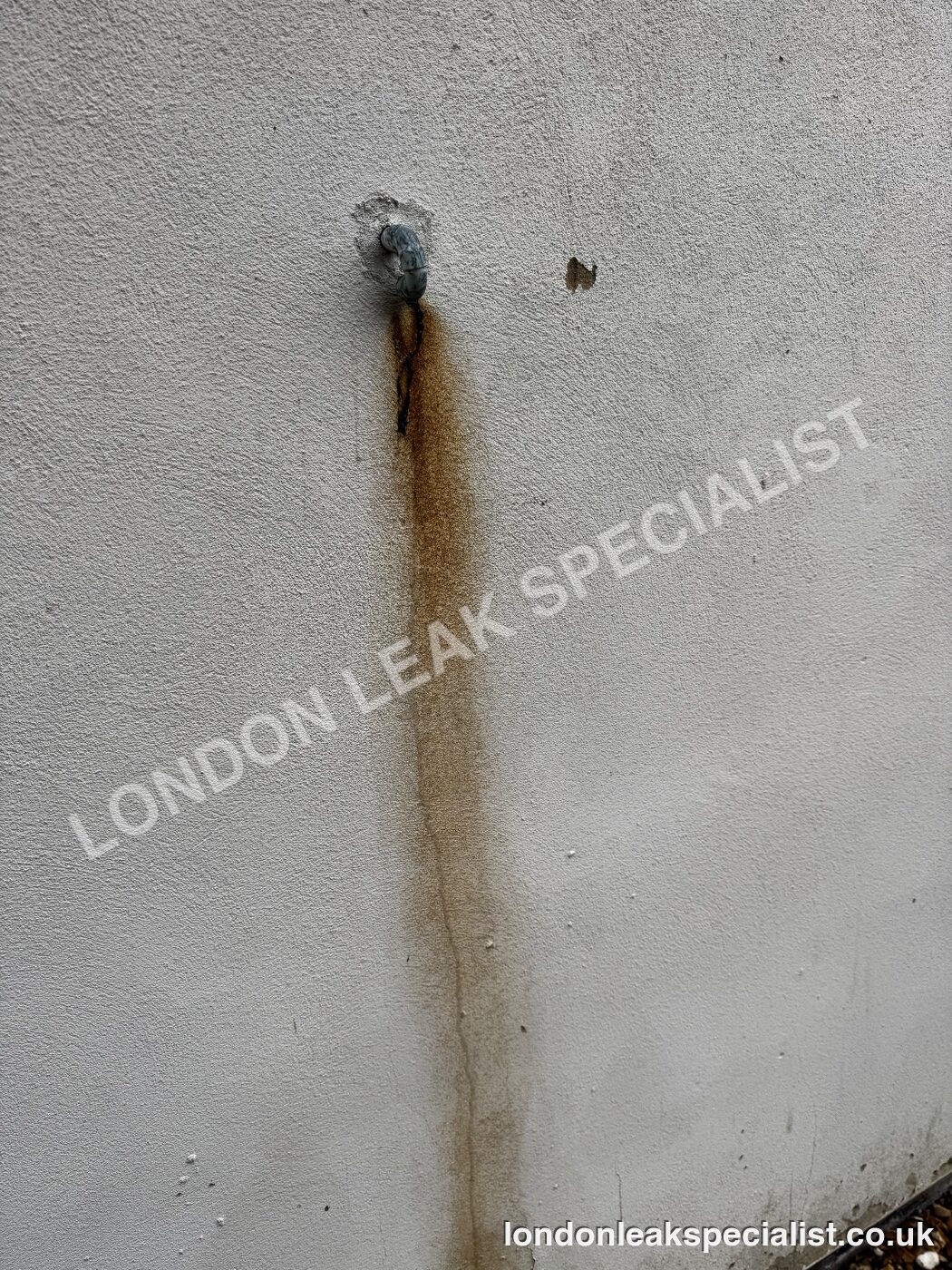
The rust streak beneath the pressure relief valve outlet on an external wall at a house in Buckhurst Hill, IG9.
A house in Buckhurst Hill, IG9, was being refurbished and its boiler kept dropping pressure. Everyone suspected the pipes under the new screed. Tracer gas, thermal imaging and an endoscope found nothing there. The answer was a steady stream from the pressure relief valve outlet on the garden wall.
When a boiler keeps losing pressure, the usual assumption is a leak in the heating pipes, and in a house with new floors that usually means the pipes under the screed. This job, in Buckhurst Hill, IG9, in the Epping Forest District on the Essex edge of London, is a good example of why that assumption needs testing before anyone lifts a floor. The pipes were fine. The water was leaving through a different door.
We have removed the client, the address and every contact detail. You can download the redacted report as a PDF.
The brief: a refurbished house and a boiler that keeps dropping pressure
The house was part-way through a refurbishment. The boiler's heating system was losing pressure, and the question was whether water was escaping from the heating pipework concealed beneath the floor screed. That is the expensive answer, because proving it the hard way means breaking up floors.
Our own guide to why a boiler loses pressure lists the common causes. This case sits at the less obvious end of that list, which is why we did not start with the screed.
What we ruled out first, and how
We began with a visual inspection of everything accessible: pipework, floors, walls and ceilings, looking for wet patches, staining or damage. Two things stood out. Only one radiator was connected to the heating system, and two further pipe connections had been capped off incorrectly. We looked closely around both and around the radiator that was live. There was no water, no damp and no staining.
Capped ends are worth checking in a refurbishment, because a poorly sealed cap can weep. These were dry, so they were not the answer, but the report notes them because they need terminating properly before the job is finished.
The method: three tests that each answer a different question
Because the question was whether pipes under the screed were leaking, we used three methods that look for different evidence. Using more than one matters. A single clean result can mislead, and a result that agrees across methods is much harder to argue with. If you want the longer comparison, see our guide to acoustic, thermal and tracer gas leak detection.
- Tracer gas. We filled the heating pipework with a safe tracer gas mixture and scanned for it for about 1.5 hours. Gas escapes through a pipe defect much more readily than water, and a detector can pick up very small amounts above the floor. The detector stayed at zero the whole time, and the pressure gauge on the test did not move.
- Thermal imaging. With the heating on, a thermal camera showed us the route of the pipes and any abnormal heat pattern that could point to hot water escaping under the floor. There was none.
- Endoscope. Where floorboards could be lifted, a small camera on a flexible lead let us look into the voids for wet insulation, damp timber or moisture. We saw nothing wet.
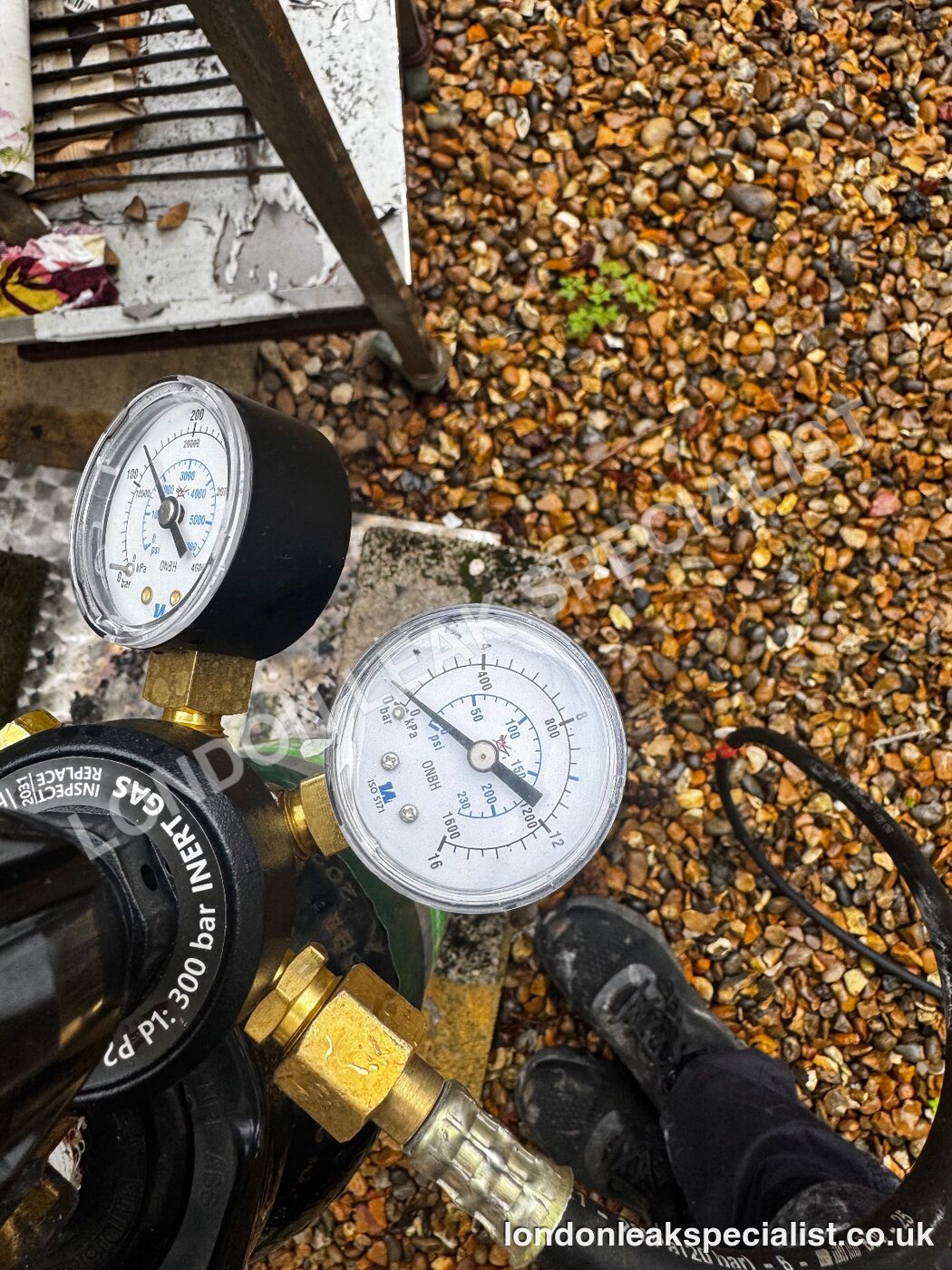
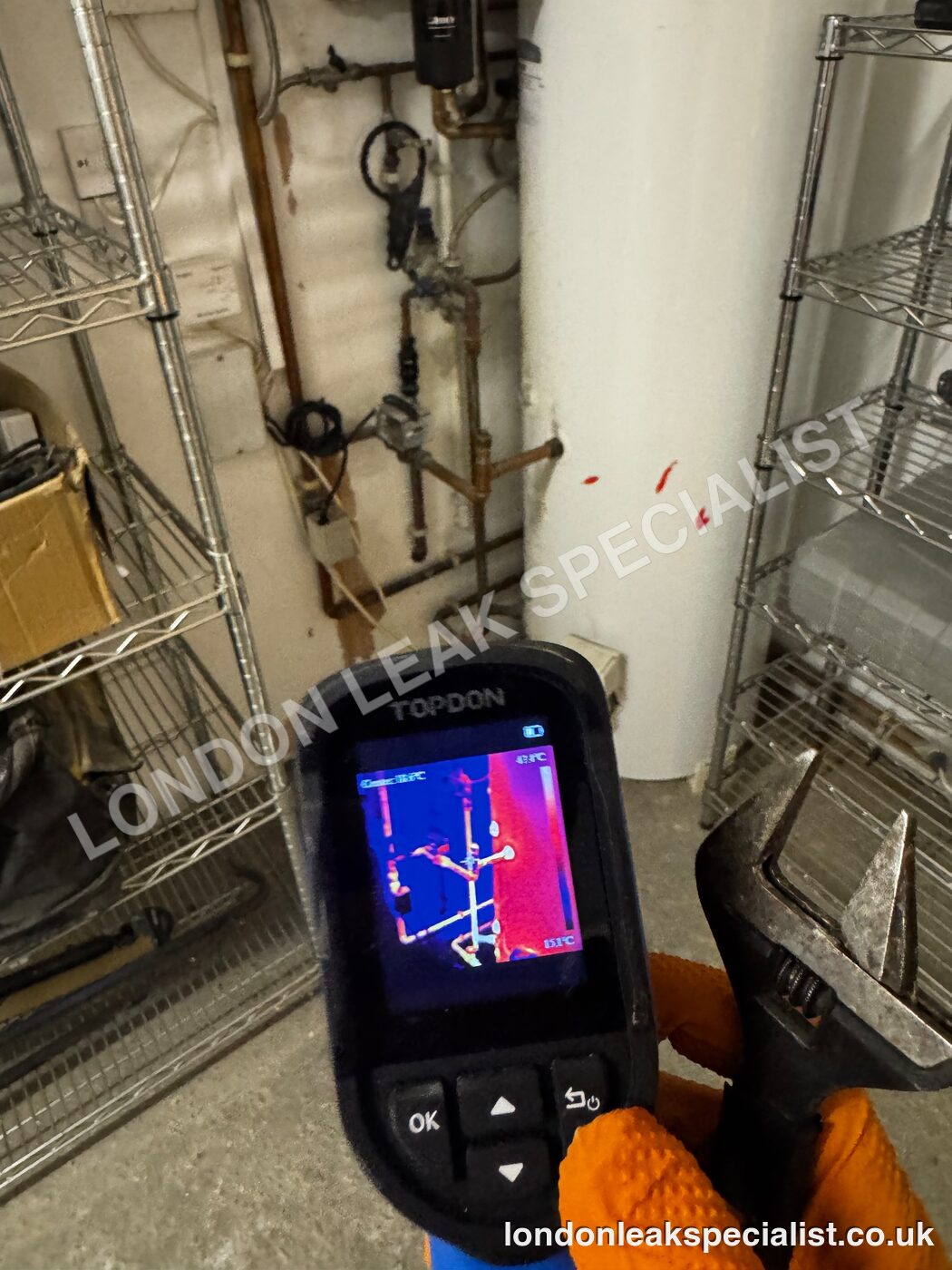
We chose tracer gas first for the screed because it is the least destructive way to find out whether a sealed heating circuit is leaking underground or under a slab. It tests the circuit and costs the property no damage. A clean result on a pressurised, stable circuit means the circuit is not the problem.

What we found: a pressure relief valve running continuously
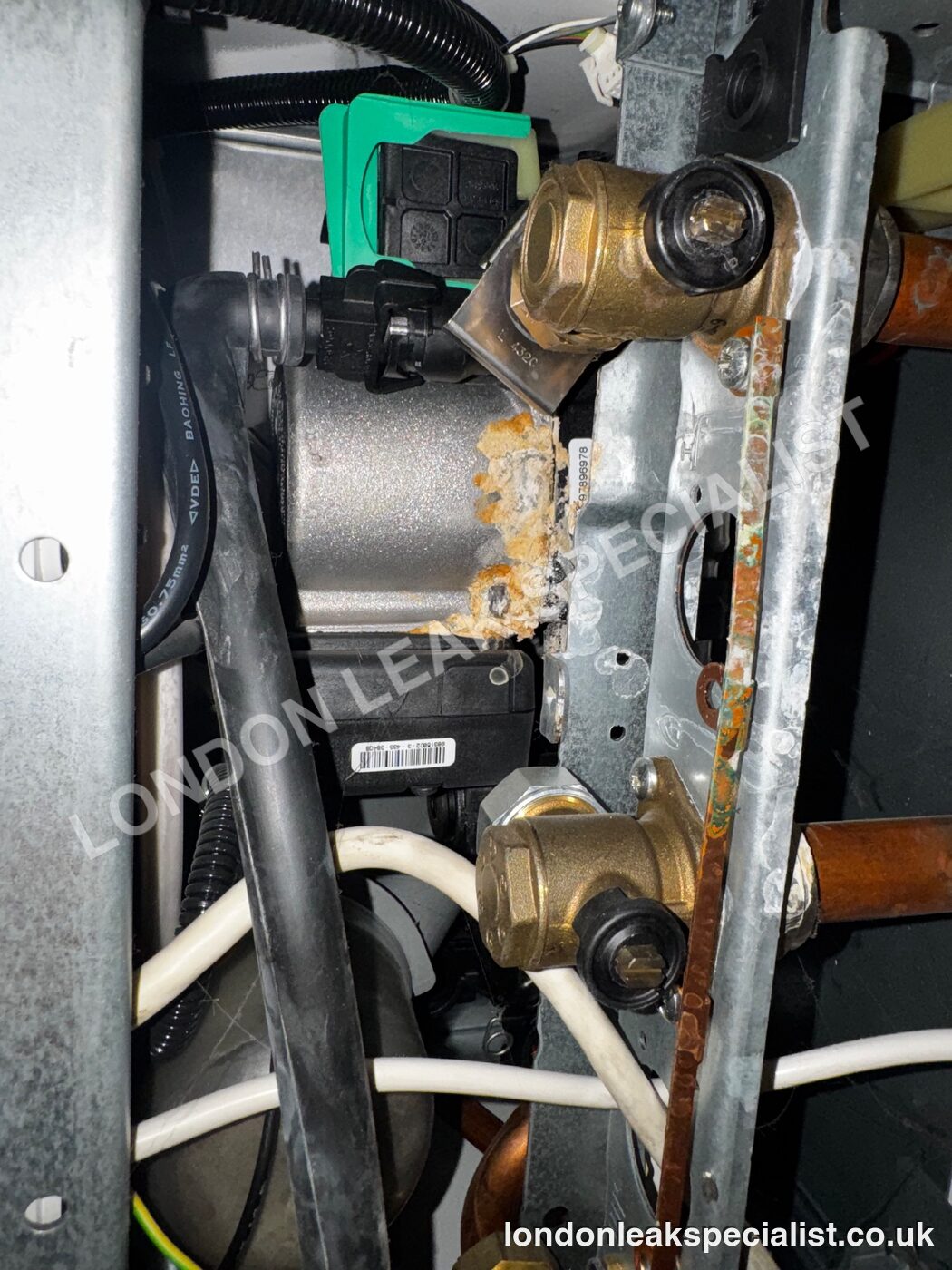
With the pipework cleared, we looked at the boiler itself. There was no drip underneath it and no damp. We did see a substantial build-up of limescale inside the boiler. The report is careful about that: limescale was noted, but its presence alone does not prove the cause of the pressure loss.
With nothing leaking indoors, the next place to check was where the boiler is designed to let water out. A boiler's pressure relief valve has a discharge pipe that runs outside, usually through an external wall, so that excess water goes somewhere safe. On the garden wall, water was coming out of it in a continuous stream.
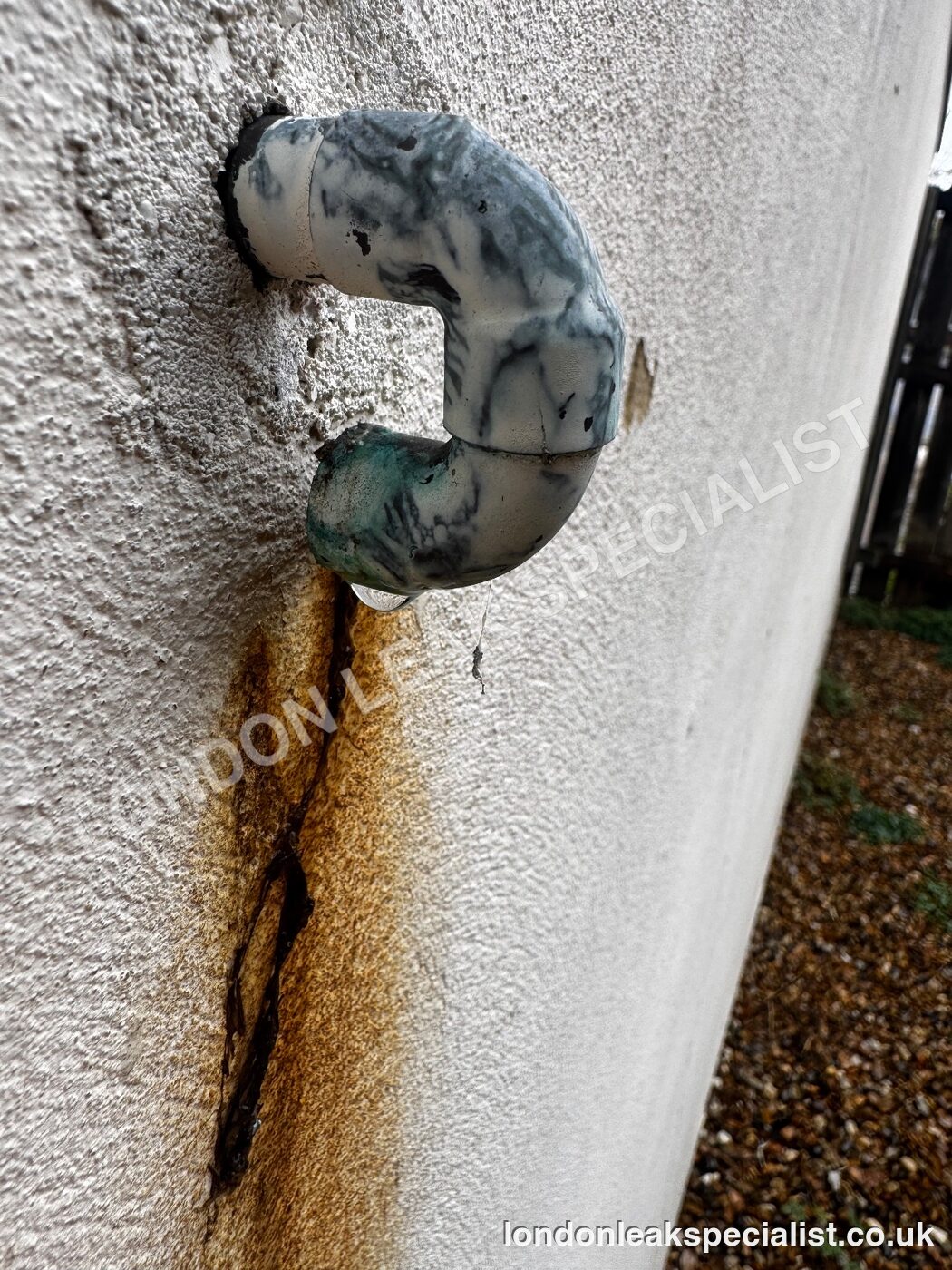
That is a direct explanation. A pressure relief valve is meant to open only when the system pressure goes above its limit. If it does not close properly afterwards, or its sealing is compromised, it keeps releasing water. The system loses water, the gauge drops, and the owner tops it up again. That matches what the household reported.
The report says what it can and cannot conclude. The continuous discharge is the identified cause of the pressure loss, rather than a detectable leak from the concealed pipework we tested. It does not diagnose why the valve is discharging, and that is a job for the heating engineer.
Buckhurst Hill, IG9 and the Epping Forest District
Buckhurst Hill sits on the Essex side of the boundary with the London Borough of Redbridge, a short distance from Woodford. A lot of the housing there is older family houses that are extended, refurbished and re-plumbed over the years, which is exactly the situation where capped redundant pipes, new screed and an old boiler meet. That mix is why we test each part of the system rather than guessing. We attend IG9 and the surrounding Epping Forest District. If you are just across the border, see our leak detection in Redbridge page and the Woodford page.
What we did on the day
This was an investigation, so we did not repair the valve ourselves. On the day we inspected the accessible property, ran the tracer gas test for about 1.5 hours, scanned with thermal imaging, used the endoscope under lifted boards, checked the boiler and its underside, and traced the discharge to the external wall. The report was written so the owner could hand it straight to a heating engineer. Any pipework repair or make-good that follows, including the capped connections, we can quote so the work is done properly and finished to like-new rather than patched. Work on the boiler itself is gas work, and under the Gas Safety (Installation and Use) Regulations 1998 a business doing in-scope gas work must be on the Gas Safe Register, so use a registered engineer. The Health and Safety Executive explains the requirement on its own site.
What permanent repair is needed
The report's recommendations, in order:
- A suitably qualified boiler engineer assesses the pressure relief valve and replaces it if it is not closing and sealing correctly.
- The whole discharge arrangement is inspected to confirm it is installed correctly and secure.
- The system is refilled and repressurised after the work, run, and checked to confirm the valve has stopped discharging and the pressure holds.
- Pressure is monitored for a suitable period afterwards.
- The two incorrectly capped connections are reviewed and properly terminated as part of the refurbishment.
The report also says that if the system still loses pressure after the valve is sorted, further investigation may be needed. That is an honest limit, and the right one to put in writing.
Why this saved time, money and damage
The obvious route was to open the floors. That is the route we avoided, and the reasoning matters more than any number.
- It avoided breaking up screed on a suspicion. Concealed pipe repairs mean taking up finished floors in a house that is being refurbished. Three methods agreeing that the pipes were sound meant none of that was needed.
- It stopped a repeat problem. If someone had replaced a section of pipe on a guess, the valve would still have been running and the pressure would have dropped again.
- It pointed the repair at the right trade. The report went to the engineer who can fix the valve rather than to a contractor looking for a pipe.
What an insurer, agent or landlord looks for in a report like this
Whoever reads a report like this wants the tests listed, the readings, what was inspected, what could not be tested and a clear opinion with its limits. This job is about a worn or failing component rather than a sudden escape of water, so it is unlikely to be an insurance matter, and many policies exclude gradual wear. We cannot promise cover for anything, and some policies treat a failed valve differently from damage caused by escaping water. Our report gives an insurer, if one is involved, the evidence to decide. Our guide to insurance leak claims explains what insurers ask for. For a rented property, the same report tells a landlord or agent exactly which repair to instruct. Our pricing page lists the public rate, which is £160 an hour.
If your problem is underfloor heating rather than a boiler valve, our guide to underfloor heating leaks and the W12 tracer gas case study cover the pipework side.
What you can check yourself
- Look for the discharge pipe outside. It usually comes through an external wall near the boiler. Water dripping or running from it, or a rust or green streak below it, points to the relief valve. It works because the valve is designed to vent outside, so that is where lost water will appear.
- Write down the pressure. Note the gauge reading cold, and again after the system has been heating. A reading that climbs high when hot suggests the valve may be opening, while a steady slow fall points to a leak elsewhere.
- Check radiator valves and pipe joints. Run a dry tissue along them. Small weeps show as damp tissue before they show as a stain.
- Do not keep topping up without a note. Each top-up is evidence of how much water is being lost. Keeping a log of dates gives the engineer something to work from.
- Leave the valve and boiler internals to an engineer. Releasing or interfering with a relief valve can cause scalding or a flood, and the boiler is gas work.
Boiler losing pressure in Buckhurst Hill, IG9, Woodford or anywhere in London and the home counties? We test the pipework without opening floors and write the report an engineer, landlord or insurer can act on. If we do not find your leak, you do not pay.
How we help with this
If the article describes a problem you actually have, these are the visits that deal with it.
- central heating leak detection
For a boiler losing pressure or a circuit that will not hold.
- leak detection in London
Finding a hidden leak without opening the property up first.
- acoustic leak detection
Ground microphones and correlators on a pressurised pipe.
Not sure which one applies? Describe the symptom on the phone and you will be told which survey it is, the hourly rate and roughly how long it takes, before anything is booked. 020 7123 8560
Frequently asked questions
Why does my boiler keep losing pressure with no visible leak?
Water can leave through the pressure relief valve discharge pipe outside, as in this Buckhurst Hill, IG9 case, or from concealed pipework under a floor. We test the pipework with tracer gas and thermal imaging first, then check where the boiler vents.
Can a pressure relief valve cause a boiler to lose pressure?
Yes. If the valve does not close properly after opening, or its seal is compromised, it releases water continuously. The system loses water and the gauge falls. An engineer should assess it and replace it if it is not sealing.
How do you find a leak under a floor screed without digging?
We fill the heating circuit with a tracer gas mixture and scan above the floor for about an hour and a half, watch the pressure gauge, run thermal imaging with the heating on, and use an endoscope where boards can be lifted. A stable gauge and zero readings show the pipework is sound.
Does limescale in a boiler cause pressure loss?
Limescale is a sign of hard water and a reason for a service, but on its own it does not prove the cause of a pressure drop. In this case it was noted in the report, and the continuous relief valve discharge was the identified cause.
Do you cover leak detection in Buckhurst Hill and the Epping Forest District?
Yes. We attend Buckhurst Hill, IG9 and nearby Woodford and the Epping Forest District. We find the source or show where it is not, write a report agents and engineers can use, and can quote the permanent repair and make-good.