Acoustic vs Thermal vs Tracer Gas: How Leak Detection Methods Compare
No single instrument finds every leak. Here is an honest comparison of the three core methods — and why good engineers carry all of them.
Ask three leak detection companies how they find leaks and you may get three different one-word answers: sound, heat, gas. All three are telling the truth and none of them is telling the whole story. Each method exploits a different physical side-effect of escaping water, and each has conditions where it excels and conditions where it is nearly useless.
Acoustic detection: following the sound
How it works: water forced through a small opening under pressure produces vibration — a hiss transmitted along the pipe and into the surrounding structure. Ground microphones and listening sticks amplify it; on longer runs, a correlator measures the time difference between the noise arriving at two sensors and calculates the leak position between them.
Where it wins: pressurised metal pipes, buried mains, leaks under concrete and paving. Correlation can locate a leak on a supply pipe to well under a metre — through a driveway.
Where it struggles: very small weeps that make little noise, plastic pipe (which damps vibration), noisy environments, and unpressurised waste pipes — which make no leak noise at all.
Thermal imaging: seeing the temperature
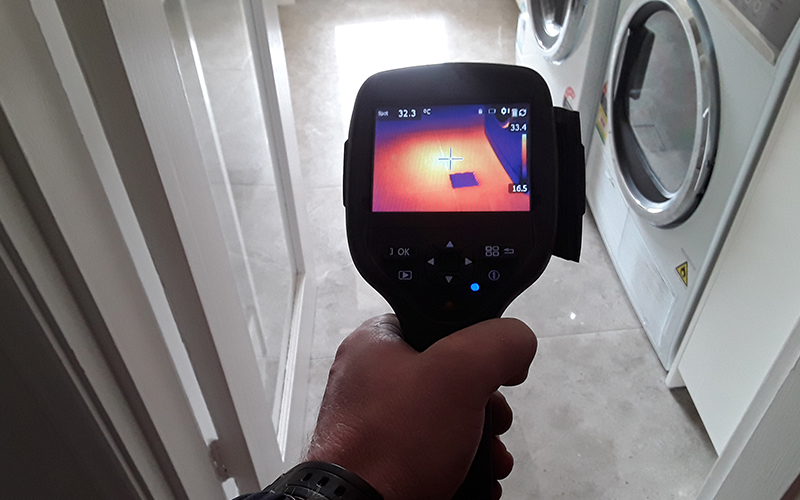
How it works: an infrared camera maps surface temperatures. A leaking hot pipe warms the material above it; evaporating cold water chills it. The camera shows pipe runs, wet patches and anomalies in real time, with no contact and no disruption.
Where it wins: heating and hot-water leaks under floors, underfloor heating loops (the whole circuit becomes visible in minutes), mapping how far moisture has spread through ceilings and walls.
Where it struggles: deep pipes whose heat never reaches the surface, cold-water leaks with weak temperature contrast, and anything the camera physically cannot see. Crucially, thermal shows where water is, not always where it escapes — water travels before it pools.
Tracer gas: the escape artist
How it works: the suspect pipe is drained and charged with a safe mix of 5% hydrogen in 95% nitrogen. Hydrogen molecules are the smallest there are; they exit through the same defect the water did and rise vertically through screed, concrete, tile or soil to a surface detector.
Where it wins: micro-leaks too quiet for acoustics, plastic pipework, deep or inaccessible runs, underfloor heating confirmation, and any case where you need certainty before excavation. It is the closest the industry has to a definitive answer.
Where it struggles: it needs the system drained (more setup time), and escaping gas can drift laterally under fully sealed surfaces like membrane floors before finding a way up — which is why readings are interpreted, not just believed.
The honest conclusion: sequencing beats loyalty
Good detection is not about owning one clever instrument; it is about the order of operations. Pressure testing narrows the search to one circuit. Thermal narrows it to an area. Acoustics narrows it to a point. Tracer gas confirms the point when the stakes justify it. That is why the meaningful question for any company is not "what technology do you use?" but "what is your process when the first method disagrees with the second?"
Our answer: we carry acoustic, thermal and tracer gas equipment on every detection visit, and no floor gets opened until two methods agree.
Frequently asked questions
Which leak detection method is most accurate?
Tracer gas typically gives the most definitive single answer, but the practical accuracy comes from combining methods: thermal to find the area, acoustic to find the point, gas to confirm it. Cross-verification is what makes centimetre-level marking reliable.
Is tracer gas safe in an occupied house?
Yes. The 5% hydrogen / 95% nitrogen mix is non-toxic and non-flammable at that concentration, and it is the standard industrial formulation used for leak testing worldwide. It disperses harmlessly after the survey.
Why did a previous company fail to find my leak?
Usually one of three reasons: they relied on a single method that suited their kit rather than your leak, the leak was not active during their visit, or the water was travelling and they found a symptom rather than the source. A second visit with a full method stack and a fresh pressure-test sequence usually resolves it.