How to Choose a Leak Detection Company in London (Without Getting Burned)
A plain-English buyer's guide to hiring a leak detection firm in London: why cheap hourly rates backfire, what real equipment looks like, how to read no-find-no-fee small print, and who is actually responsible for the pipe.
You have a damp patch spreading across a ceiling, a water meter that ticks over when every tap is off, or a boiler that keeps losing pressure. You search for a water leak detection company in London, and within an hour you have three quotes that disagree by hundreds of pounds. One firm charges by the hour. Another promises no find, no fee. A third wants a flat fee before they will even book you in. All three sound confident. Only one of them is telling you the whole story.
This guide is written to help you hire well the first time. Water leak detection is one of those trades where the cheapest headline number is often the most expensive outcome, and where the quality of the paperwork matters as much as the quality of the search. We have laid out exactly what to check, what the real costs look like, what Londoners themselves report going wrong, and how to work out who is even responsible for the pipe before you pay anyone.
Why cheap hourly rates are a trap
An hourly rate looks like the honest option. You only pay for the time used, so what could go wrong? The problem is that hourly billing quietly rewards the slowest possible search. A firm that charges by the hour has no financial reason to arrive with the right equipment, and every reason to spend the morning ruling things out one at a time.
Typical UK trade cost-guide ranges put leak detection labour somewhere around £95 to £145 per hour, with day rates running from roughly £595 to £1,500. That sounds manageable until you realise a difficult trace under a solid floor can take most of a day. Add a call-out fee, add travel time across London traffic, add a return visit because they did not bring a tracer gas kit, and the friendly hourly number becomes a bill you never agreed to.
The deeper issue is uncertainty. When you book by the hour you are signing a blank cheque, because nobody can tell you in advance how long the job will run. The recurring pattern homeowners describe is simple: the estimate on the phone and the invoice at the door are two different numbers, and the gap is always in the firm's favour.
a fixed hourly detection rate flips the incentive. When a company agrees the price before it arrives, speed and skill become its problem rather than yours. This is why we quote a fixed hourly detection rate at booking, typically £340–£680 in total for a London home, so the rate is settled before anyone lifts a floorboard. You can see how that works on our pricing page.
What equipment a real firm actually brings
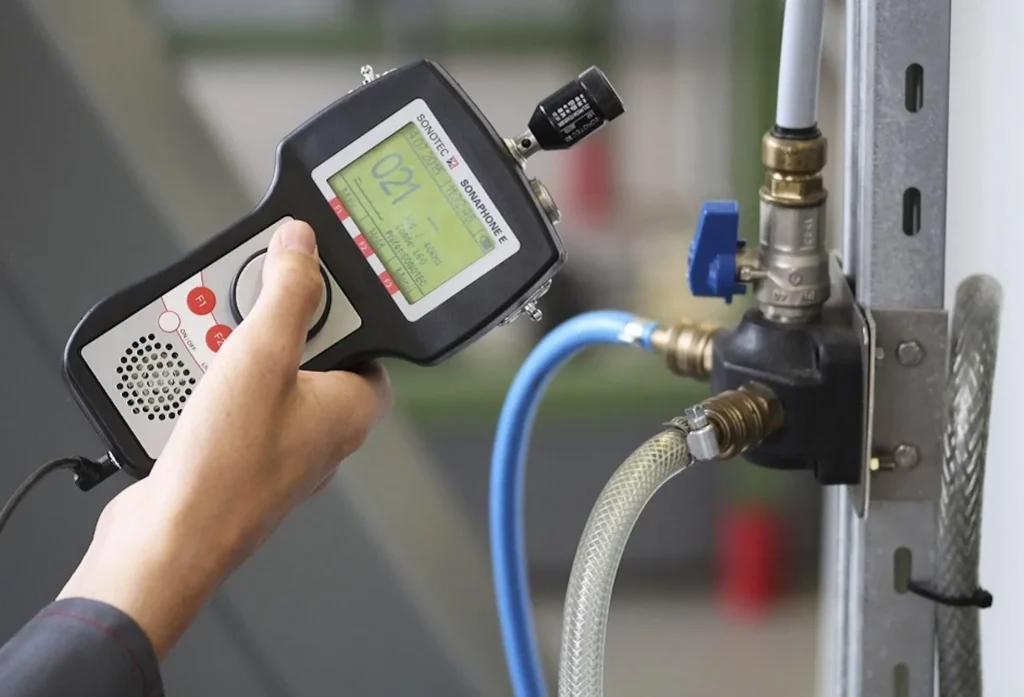
The single fastest way to separate a genuine leak detection specialist from a general plumber with a damp meter is to ask what they bring in the van. Non-invasive detection depends on using several methods together, because no single tool finds every leak. Water under a screed behaves differently from water inside a wall cavity, which behaves differently again from a slow weep on a central heating pipe.
A properly equipped firm should be able to describe, without hesitation, how it combines the following:
- Acoustic detection uses ground microphones and correlators to hear pressurised water escaping, even under concrete. It is the backbone of mains and supply-pipe tracing.
- Thermal imaging reads temperature differences across surfaces, which is how a heated-floor leak or a hot-water pipe shows up without lifting a single tile.
- Tracer gas introduces a safe hydrogen and nitrogen mix into the pipework, which rises to the surface at the exact escape point. It is the method that finds the leaks acoustics alone miss.
- Moisture mapping uses calibrated meters to map how far water has travelled, so the source is separated from the staining, which is often nowhere near it.
- Pressure testing confirms whether a pipe circuit actually holds, and proves the leak is fixed once the repair is done.
A firm that only owns a damp meter will guess, then break something to check the guess. A firm that owns the full kit narrows the location before it opens anything up. That difference is the whole point of paying for detection rather than for demolition. You can read more about how we combine these on our leak detection London page.
Reading the no-find-no-fee small print
No find, no fee is an attractive promise and, in the right hands, a fair one. It says the firm is confident enough to stake its fee on results. The trouble is that the phrase has no fixed legal meaning, so what counts as a find and what counts as a leak is defined entirely by the small print you did not read.
The recurring forum pattern is depressingly consistent: the guarantee sounded absolute on the phone, then excluded the exact thing that was actually wrong. Before you accept any no-find-no-fee offer, get written answers to these questions:
- Does the guarantee cover heating and central heating leaks, or only fresh-water plumbing?
- Does it cover the mains supply pipe, or stop at the internal stopcock?
- If they locate the leak but cannot pinpoint it to the centimetre, does that count as a find you still pay for?
- Is there a call-out or survey charge that applies even when nothing is found?
- What happens if the cause turns out to be condensation, a failed seal, or an expansion vessel rather than a pipe leak?
That last point matters more than people expect, and we come back to it below. A trustworthy firm will tell you its exclusions up front and put them in writing. If a company is vague about what its guarantee does not cover, treat the vagueness as the answer.
Why the report decides your insurance payout
Here is the part most homeowners discover too late. If you intend to claim on buildings insurance for water damage, the money does not follow the leak. It follows the paperwork. Insurers pay against a document, commonly called a trace and access report, that proves a professional located the source, recorded the method, and documented the access needed to reach it.
A verbal finding and a fixed pipe are not a claim. A photograph of a damp ceiling is not a claim. What your insurer wants is a clear, dated report that identifies the leak location, the detection methods used, the damage caused by gaining access, and the remedial work required. Trace and access cover is a standard feature of most buildings policies precisely because insurers expect this evidence, and they routinely reject or reduce payouts when it is missing or thin.
This is why the cheapest hourly plumber can cost you the most. He finds the leak, fixes it, hands you an invoice on a scrap of paper, and leaves you with nothing an insurer will accept. You then pay for the repair, the redecoration, and the drying yourself. A specialist who issues an insurer-ready report is not adding a luxury; they are protecting the four-figure claim that pays for everything else. We produce insurer-ready reports as standard, which you can read about on our trace and access London page.
Rule out the boiler and expansion vessel first
Not every pressure drop is a leak, and this single misunderstanding costs London homeowners a great deal of wasted money. If your combi or system boiler keeps losing pressure and you have no visible water anywhere, the culprit is very often a failed expansion vessel rather than a hole in a pipe.
The expansion vessel is a sealed tank inside or near the boiler that absorbs the extra volume as heated water expands. When its internal air charge fails, the system cannot cope with expansion, pressure swings wildly, and the pressure relief valve may weep outside. The symptom looks exactly like a hidden leak: pressure that will not hold. The fix is a re-charge or a replacement vessel, which a competent heating engineer handles in an hour or two, at a fraction of the cost of a full leak trace.
A recurring forum theme is homeowners paying for leak detection, or worse for exploratory floor lifting, when the real fault was a twenty-year-old expansion vessel. A good detection firm will ask about your boiler pressure behaviour before it books a full survey, and will tell you honestly if the pattern points to a heating fault rather than a pipe. Any firm that rushes you toward an expensive trace without first ruling out the obvious heating causes is not acting in your interest.
Who is actually responsible for the pipe
Before you pay for detection at all, work out whether the pipe is even yours to fix. In London the answer is often no, and the responsible party may cover the cost entirely.
For a house, the boundary generally falls at the edge of your property. The supply pipe running from the boundary into your home is your responsibility as the homeowner. The communication pipe and the main in the street belong to Thames Water. If the leak is on their side of the boundary, it is their repair and their bill. Thames Water also runs support schemes for certain customers, so it is always worth reporting an external leak before you commission private work.
For a flat or a leasehold property, responsibility usually splits between you and the freeholder or managing agent. Communal risers, shared stacks, and the structure itself are typically the freeholder's responsibility, while the pipework serving only your flat is usually yours. Water travelling down from a flat above is almost never something you pay to investigate alone. The table below summarises the common cases.
| Situation | Usually responsible | First step |
|---|---|---|
| Leak on the street main or communication pipe | Thames Water | Report it to Thames Water before hiring anyone |
| Supply pipe between boundary and a house | Homeowner | Commission private detection |
| Internal plumbing in your own home or flat | Homeowner or leaseholder | Commission private detection, then claim if insured |
| Communal riser or shared stack in a block | Freeholder or managing agent | Notify the managing agent in writing |
| Water coming down from the flat above | Upstairs leaseholder or freeholder | Notify neighbour and managing agent before paying |
Sorting out responsibility first can save you the entire cost of the job. It also tells you who to send the report to when it is done.
What Londoners report going wrong
Across r/AskUK, r/DIYUK and r/HousingUK on Reddit, and on MoneySavingExpert and the DIYnot forums, the same complaints surface again and again. None of the following are invented; they reflect the general consensus in those communities, described honestly rather than through fabricated quotes.
- Surprise hourly bills. Homeowners repeatedly report that an hourly or day rate quoted on the phone grew well beyond the estimate once call-out fees, travel and a second visit were added.
- Guarantees that exclude the actual fault. A recurring pattern is a no-find-no-fee promise that turned out to exclude heating systems or the mains supply, which was exactly where the leak was.
- Expansion vessel faults sold as leaks. Several threads describe paying for leak investigation on a boiler that kept losing pressure, only to learn the real cause was a failed expansion vessel that a heating engineer could have diagnosed cheaply.
- Wildly varying quotes. People report gathering three or four quotes for the same job and receiving numbers hundreds of pounds apart, with no clear explanation of what the higher price actually bought.
- Reports too thin for insurers. A common frustration is discovering, at claim stage, that the plumber's invoice did not meet the insurer's requirement for a proper trace and access report.
The through-line is that the failures are rarely about the leak itself. They are about price transparency, guarantee wording, misdiagnosis and paperwork. Every one of them is avoidable with the right questions before you book.
Your leak detection hiring checklist
Print this or keep it open while you make calls. If a firm cannot answer these clearly, keep dialling.
- [ ] Is the price a fixed hourly rate agreed before the visit, or an open-ended hourly rate?
- [ ] What detection methods do they use, and do they bring acoustic, thermal, tracer gas, moisture and pressure-testing equipment?
- [ ] Does any no-find-no-fee guarantee cover heating and the mains supply, in writing?
- [ ] Do they issue an insurer-ready trace and access report as standard?
- [ ] Will they rule out boiler and expansion vessel faults before committing you to a full trace?
- [ ] Have you confirmed whether the pipe is your responsibility, Thames Water's, or the freeholder's?
- [ ] Is there a separate call-out or survey charge, and when does it apply?
- [ ] Do they explain what happens, and what you pay, if the cause turns out not to be a pipe leak?
How our pricing compares, honestly
To put the trade ranges in context, independent UK cost guides put a single leak detection job anywhere from around £80 for a very simple trace to £1,600 for a complex one, with an average near £500. Hourly labour sits around £95 to £145, and day rates run from roughly £595 to £1,500. The spread is enormous because hourly jobs scale with difficulty and nobody can price them in advance.
Our approach is a fixed hourly detection rate agreed at booking, typically £340–£680 in total for a London home, on a no-find-no-fee basis, with a multi-method survey using acoustic, thermal, tracer gas, moisture and pressure-testing equipment, and an insurer-ready trace and access report included. The point is not that we are always the lowest headline number. The point is that you know the rate before we arrive, and that rate buys you the paperwork your insurer needs. That is usually the difference between a cost and a claim.
Choosing a leak detection company well comes down to three habits: settle the price before the visit, insist on a real report, and rule out the boring causes before paying for the exciting ones. Do those three things and you will not get burned.
Frequently asked questions
How much does water leak detection cost in London?
UK trade cost guides put leak detection anywhere from around £80 for a simple trace to £1,600 for a complex job, averaging near £500. Hourly rates run £95 to £145 and day rates £595 to £1,500. We charge a fixed hourly detection rate agreed at booking, typically £340 to £680 in total for a London home, so you know the rate before we arrive.
Does no find, no fee really mean I pay nothing?
Only if the small print says so. Many guarantees exclude heating systems or the mains supply, or still charge a call-out fee. Before you book, get written confirmation of what the guarantee covers and excludes. If a firm is vague about its exclusions, treat that vagueness as your answer and ask elsewhere.
My boiler keeps losing pressure. Is it definitely a leak?
Not necessarily. If pressure drops with no visible water, the cause is often a failed expansion vessel rather than a pipe leak. A heating engineer can re-charge or replace the vessel far more cheaply than a full trace costs. A good detection firm will ask about your boiler behaviour and rule out heating faults before booking an expensive survey.
Will my insurance cover the leak?
Most buildings policies include trace and access cover, but insurers pay against a proper report, not a verbal finding. The report must identify the leak location, the detection methods used, and the access damage. A plumber's scrap-paper invoice is often rejected. This is why an insurer-ready trace and access report matters more than the lowest hourly rate.
Who is responsible for a leaking pipe, me or Thames Water?
For a house, the supply pipe from the boundary into your home is yours, while the communication pipe and street main belong to Thames Water. In a flat, communal risers and shared stacks are usually the freeholder's responsibility. Confirm whose pipe it is before paying anyone, because the responsible party may cover the repair entirely.
Why do leak detection quotes vary so much?
Because hourly and day-rate jobs scale with difficulty, and nobody can price an unknown search in advance. Homeowners routinely report quotes hundreds of pounds apart for the same job. A fixed hourly rate agreed at booking removes that uncertainty by making the firm, not you, carry the risk of how long the trace takes.