Commercial Leak Detection for London Property Managers and Freeholders
Leaks in blocks of flats, offices and mixed-use buildings rarely start where the damage shows. This guide explains how commercial leak detection works across communal risers, flat roofs and plant rooms, and how managing agents can minimise disruption, establish liability and satisfy block insurers.
For a managing agent or freeholder in London, a water leak is rarely a simple plumbing problem. It is a coordination problem, a liability problem and, very often, a service-charge problem all at once. A stain appears on a third-floor ceiling, three leaseholders start emailing, the insurer wants a cause, and nobody can agree whose water it is or who pays to find out. The building carries on getting wetter while everyone waits.
This guide is written for the people who manage that situation: property managers, block managing agents, freeholders, right-to-manage companies and facilities managers responsible for offices, retail units and mixed-use schemes across London. It explains why commercial leaks behave differently from domestic ones, where they actually originate in concrete-frame buildings, how to trace them without ripping the building apart, and how to produce the kind of report that satisfies a block insurer and holds up in a service-charge dispute.
Why commercial leaks are a different problem
In a single house, the person who owns the leak and the person suffering the damage are usually the same. In a block of flats or a commercial building, they almost never are. The water might originate in a communal riser, travel through a structural slab, run along a service void, and emerge two floors down inside a leaseholder's demised flat. By the time it shows, it has crossed the boundary between communal responsibility and private demise at least once, and often several times.
That single fact drives most of the difficulty. Before anyone can repair anything, three questions have to be answered honestly and defensibly: where is the water coming from, what is the cause, and whose responsibility is the source under the lease and the buildings policy. Get those wrong and you either spend the service charge on the wrong repair, or you recharge the wrong party and end up in dispute.
The visible drip is rarely above the source
The most common and expensive mistake in commercial buildings is assuming the damage is directly below the leak. In a modern concrete-frame building this is almost never true. Water finds the path of least resistance. It runs along the top of a structural slab, follows the fall of a beam, tracks along conduit, cable trays or pipe insulation, pools at a movement joint, and then drops through the first crack, downlight or service penetration it reaches. That exit point can be several metres horizontally and one or two floors vertically away from where the water actually escaped.
This is why opening up the ceiling directly under a stain so often finds nothing. The plasterboard comes down, the ceiling void is dry, and the search starts again, now with a hole in someone's flat and a leaseholder who is understandably unhappy. Effective commercial leak detection works backwards from the exit point, tracing the water uphill and upstream to its true origin, rather than assuming vertical alignment that concrete-frame construction rarely provides.
Where commercial leaks actually come from
Across London blocks, offices and mixed-use buildings, a relatively small number of sources account for the majority of serious leaks. Knowing them helps a managing agent brief a contractor sensibly and challenge lazy diagnoses.
- Communal risers and stacks. Vertical runs of hot, cold, heating and soil pipework serving multiple flats. A weeping joint or corroded section high in a riser can feed water down through several floors, presenting in flats that share nothing but the shaft.
- Flat roofs and terraces. Ageing felt, single-ply membranes, failed upstands, blocked outlets and cracked balcony waterproofing. Roof leaks are notorious for travelling far before appearing, and for being intermittent with rainfall.
- Plant rooms and communal heating. Pressurised heating circuits, boilers, buffer vessels, pumps and the pipework feeding them. A slow drop in system pressure often points to a hidden leak on a buried or concealed heating pipe.
- Service voids and ceiling voids. The concealed spaces above suspended ceilings and below raised floors where pipework, valves and connections sit out of sight and out of maintenance.
- Underground and buried mains. Incoming supplies and distribution pipework beneath car parks, courtyards and ground-floor slabs, where losses can run for months before surfacing.
- Demised plumbing that crosses boundaries. A leak from within one leaseholder's flat, such as a failed shower tray, waste connection or washing-machine feed, that damages the flat below and is easily mistaken for a communal fault.
Non-invasive, multi-method water leak detection
The phrase to hold on to when instructing any leak specialist is non-invasive and multi-method. No single piece of equipment finds every leak. A credible commercial approach combines several complementary techniques, chosen for the building and the symptoms, and only opens up the fabric once the evidence points to a specific location. Our commercial leak detection in London service is built around exactly this principle: prove the origin first, disturb the building last.
The main methods used together typically include the following.
- Thermal imaging. Infrared cameras reveal temperature differences across walls, floors and ceilings, highlighting the cool signature of evaporating water or the warm track of a heating leak beneath a slab.
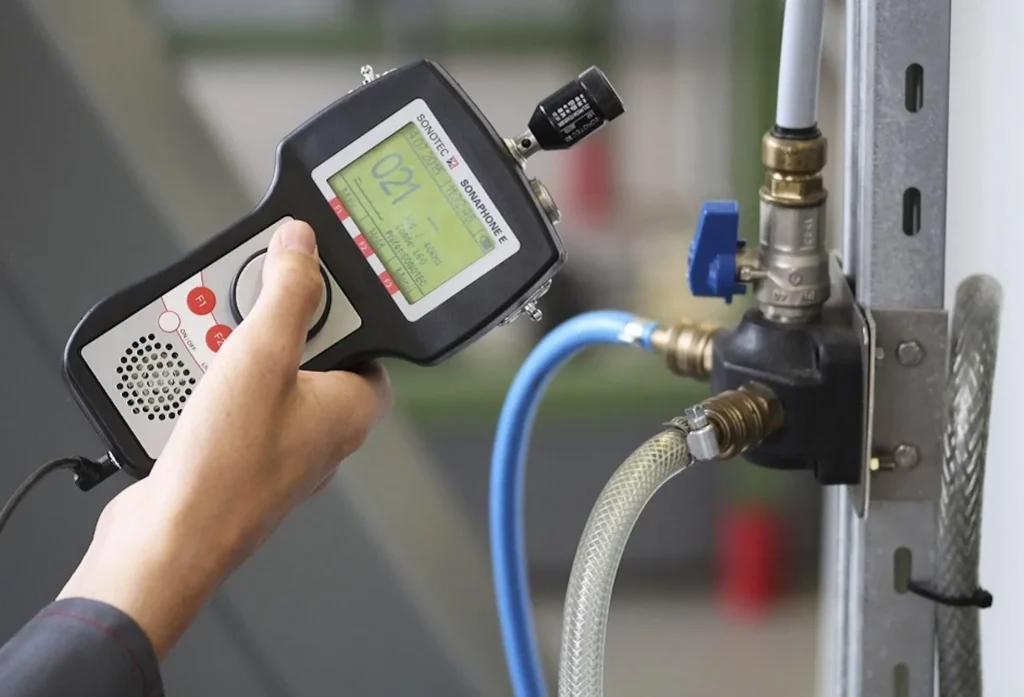
- Acoustic detection. Sensitive listening equipment picks up the sound of water escaping a pressurised pipe, allowing a leak on a buried or concealed line to be pinpointed through the structure.
- Tracer gas. A safe, inert gas mixture is introduced into the isolated pipework; where it escapes at the leak, gas-sensitive detectors find it at the surface. This is particularly effective on pressurised heating and water systems.
- Moisture mapping and calibrated meters. Surface and deep-reading moisture meters map the true extent of water within the fabric, distinguishing an active leak from historic staining.
- Pressure testing and flow analysis. Isolating and testing individual circuits and supplies to confirm which system is losing water and how quickly.
- Camera inspection. Endoscope and drain cameras used inside voids, stacks and drainage runs to inspect what cannot be seen directly.
Used in combination, these methods let a specialist confirm the source before a single tile or plasterboard sheet is removed. That is the whole point of trace and access as a discipline: the trace establishes where and why, and the access is then surgical, targeted and minimal.
Minimising disruption and liability
In an occupied building, the cost of a leak is not only the water. It is the retail unit that cannot trade, the office floor that has to be cordoned off, the corridor carpet that has to be lifted, and the reputational cost to a managing agent whose residents feel ignored. A non-invasive approach protects all of that. Fewer holes means less making-good, less redecoration, less disturbance to tenants, and a smaller bill against the service charge.
Liability is the other side of the same coin. Every hole opened without justification is a potential dispute about who authorised it and who pays to reinstate it. When detection is evidence-led, each intervention can be justified against the trace findings. That protects the agent, the freeholder and the residents alike, and it makes the eventual recharge far easier to defend.
Coordinating access across leaseholders and tenants
Access is frequently the hardest part of a commercial leak job, and it is where managing agents add the most value. A leak presenting in one flat may need investigation in the flat above, in the communal riser cupboard, and on the roof, which means arranging entry across several parties who owe each other nothing directly. Practical coordination usually means:
- Identifying every unit and communal area potentially on the water's path, not just the one reporting damage.
- Giving leaseholders and tenants proper written notice of access, with a clear reason and a realistic time window.
- Sequencing the visit so a single attendance can cover multiple areas, rather than repeated trips that multiply cost and irritation.
- Being clear in advance about what is communal and what is demised, so nobody feels a private space is being entered without cause.
A specialist who is used to working with block management understands that they are a guest in occupied homes and businesses, and that the agent's relationship with residents has to survive the investigation. Booking a single, well-planned attendance that covers the flat, the void and the riser in one visit is worth a great deal more than a cheaper quote that turns into three disruptive return trips.
Insurer-ready reports for block policies and disputes
For a managing agent, the report is often more valuable than the detection itself. Most blocks are covered by a buildings policy held by the freeholder or the RMC, and most insurers will not entertain a trace-and-access or escape-of-water claim without a clear, independent account of cause and origin. A vague invoice that says "attended and investigated leak" rarely satisfies a claims handler.
An insurer-ready report should establish, in plain terms, the following.
| Report element | Why it matters |
|---|---|
| Cause | What failed and why, for example a corroded riser joint or a failed roof membrane, so the insurer can assess the peril |
| Origin | The precise location of the source, distinguishing communal pipework from demised plumbing |
| Method and evidence | Which detection techniques were used and what they showed, including thermal images and moisture readings |
| Extent of damage | Moisture mapping of the affected areas to scope drying and reinstatement accurately |
| Responsibility indication | Whether the source sits in communal or private demise, informing both the claim and any recharge |
| Recommended remedial action | A clear next step so repair can proceed without a second investigation |
The same report does double duty in service-charge disputes. When leaseholders question whether a repair is a communal cost or a private one, an independent trace report that identifies the origin removes much of the argument. It gives the agent a defensible basis for how costs are allocated, and it demonstrates that the freeholder acted reasonably in investigating before spending. Our reports are prepared with block policies and cost-allocation questions in mind, so they can be handed straight to an insurer or shared with leaseholders as evidence of cause and origin.
What commercial leak detection typically costs
Managing agents work to budgets and have to justify spend against the service charge, so honest cost expectations matter. Commercial leak detection is priced on the complexity of the building and the systems involved rather than a flat domestic rate. As a broad guide, typical UK trade cost-guide ranges for professional non-invasive water leak detection tend to fall somewhere between roughly 300 and 700 pounds for a straightforward investigation, with larger commercial jobs involving multiple floors, extensive risers, plant rooms or underground pipework sitting higher depending on scale and access.
The figures above are indicative ranges drawn from general trade cost guidance, not a quotation, and every building is different. What matters more than the headline number is how the fee is structured. We agree a fixed hourly rate at the point of booking, based on the information you provide about the building and the symptoms, so there is no open-ended day rate and no surprise on the invoice. For a managing agent presenting costs to a board or to leaseholders, a known figure agreed in advance is far easier to defend than an hourly charge that could run anywhere.
Planned and preventive approaches for managing agents
The best leak is the one that never floods a retail unit on a Saturday. While detection is often reactive by nature, there is a growing consensus among property professionals that a purely reactive stance is expensive over the life of a building. A more planned approach can reduce both the frequency and the severity of escape-of-water events.
- Understand the building's systems. Keep an accurate record of risers, isolation valves, plant and roof construction, so that when a leak does occur the search starts from knowledge rather than guesswork.
- Monitor communal heating pressure. A slow, repeated loss of system pressure is one of the earliest signals of a hidden leak on a pressurised circuit, often long before any damage shows.
- Inspect flat roofs and terraces on a cycle. Clearing outlets and checking membranes and upstands before winter catches many problems while they are still cheap to fix.
- Act early on minor stains. A small ceiling mark investigated promptly is a modest fixed-fee job; the same leak left for a year can mean structural drying, mould and a large insurance claim.
- Consider leak detection as part of major works planning. When a block is due for pipework, roofing or communal heating renewal, understanding existing weaknesses first helps specify the works correctly.
None of this removes the need for reactive detection, but it changes the economics. Agents who build leak awareness into planned maintenance tend to face fewer emergencies, smaller claims and calmer residents. When something does go wrong, they already know the building well enough to get a specialist to the source quickly. You can read more about our general approach on the leak detection in London page.
A sensible process for the next leak
When the next report of a damp ceiling lands in your inbox, a clear process saves money and goodwill. Resist the urge to open up beneath the stain. Gather the basic facts: which units are affected, when it started, whether it tracks with rainfall or with heating use, and what systems run through that part of the building. Instruct a non-invasive, multi-method trace so the origin is proven before anything is disturbed. Coordinate access across the flats, voids and communal areas likely to be on the water's path in a single planned visit. Then use the resulting insurer-ready report to drive the repair, the insurance claim and any cost allocation, all from the same evidence.
Handled this way, a leak stops being a source of disputes and becomes a manageable, documented event. That is the difference a proper commercial approach makes for property managers and freeholders across London.
Frequently asked questions
Why does the water damage appear so far from the actual leak?
In concrete-frame commercial buildings water rarely falls straight down. It runs along the top of the structural slab, follows beams, pipe insulation and cable trays, and drops through the first crack, downlight or service penetration it finds. That exit point can be several metres sideways and one or two floors below the true source, which is why opening up directly beneath a stain so often finds nothing. Detection has to trace the water backwards to its origin rather than assume it is directly above the damage.
Who pays for water leak detection in a block of flats, the freeholder or the leaseholders?
It depends on the lease and on where the leak originates. If the source is communal pipework, a riser or the roof, the cost usually falls to the freeholder or management company and is generally recoverable through the buildings policy and the service charge. If the source is within a leaseholder's demised flat, it is typically their responsibility. This is exactly why an independent trace report that establishes cause and origin matters so much, because it gives a defensible basis for allocating cost before any dispute begins.
Will you need to take down ceilings and open up walls to find the leak?
Not to find it. Our approach is non-invasive and multi-method, combining thermal imaging, acoustic detection, tracer gas, moisture mapping, pressure testing and camera inspection to pinpoint the source before anything is opened up. Any access to the fabric afterwards is targeted to the confirmed location, which keeps making-good, disruption and cost to a minimum in occupied flats, offices and retail units.
Can your report be used for an insurance claim on our block policy?
Yes. Our reports are prepared with block buildings policies in mind and set out the cause, the origin, the detection methods used, the evidence including thermal images and moisture readings, the extent of damage, and a recommended remedial action. Most insurers will not settle a trace-and-access or escape-of-water claim without this kind of independent account of cause and origin, so the report is designed to be handed straight to a claims handler.
How do you handle access when the leak crosses several flats and tenants?
We plan the attendance around every area likely to be on the water's path, not just the unit reporting damage, and we work with your notice arrangements so leaseholders and tenants are given a clear reason and a realistic time window. Where possible we cover the affected flat, the communal riser and the roof or void in a single visit, which reduces both cost and the disturbance to residents compared with repeated return trips.
How much does commercial leak detection cost and how is the fee agreed?
Typical UK trade cost-guide ranges for professional non-invasive detection tend to run from roughly 300 to 700 pounds for a straightforward investigation, with larger multi-floor or plant-room jobs sitting higher depending on scale and access. Those are indicative ranges rather than a quotation. We agree a fixed hourly rate at the point of booking based on the building and the symptoms you describe, so there is no open-ended day rate and the figure can be presented to a board or leaseholders with confidence.